A passion for access
- This article was written for 603 Diversity, a sister publication to NH Business Review that is also produced by Yankee Publishing.
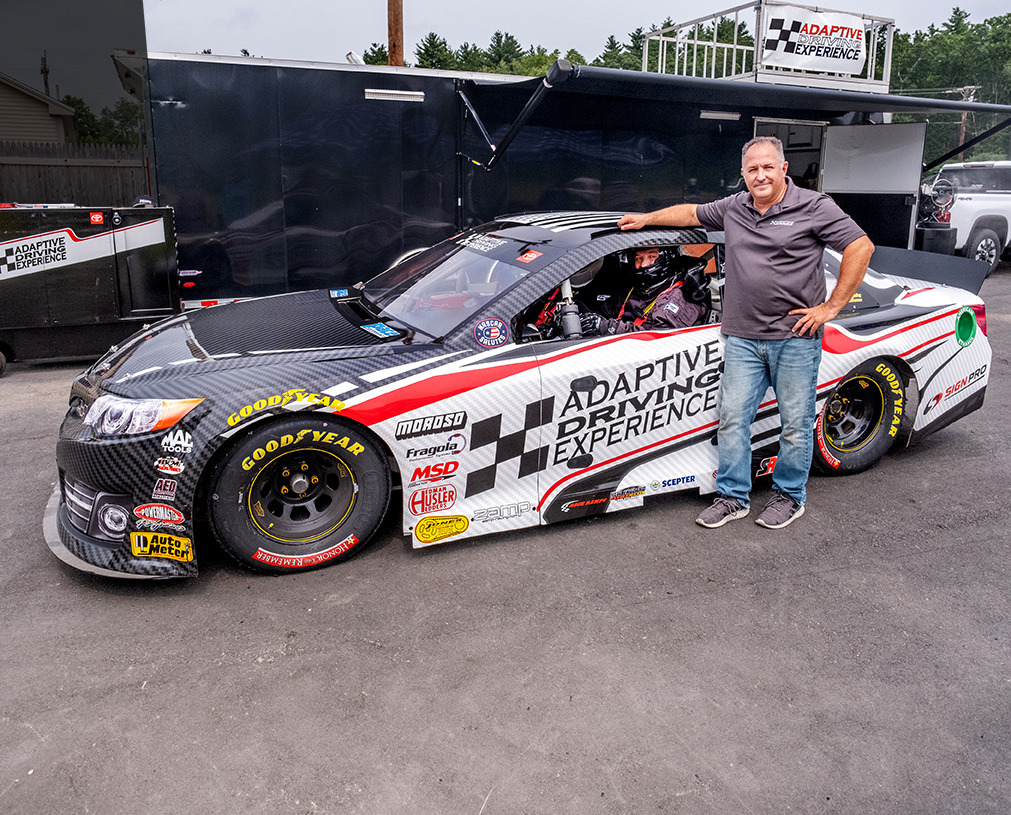
Derry resident Danny Chrissanthis doesn’t have a physical disability, nor did he know anyone with any such condition 12 years ago when he became involved with what’s now been an over-decade-long automotive project. But when the opportunity to build a race car that could accommodate disabled drivers or passengers presented itself, he took it.
Chrissanthis, the director of Adaptive Driving Experience (ADE), said it was a combination of extending his passion for stock car auto racing and seeking a “purpose in life” that motivated him and others to become part of the Derry-based nonprofit.
“This is what drives us,” he said. “I was able to be part of a few events that gave me a taste of what the end result is with these drivers who get to come in, not ever thinking they could get behind the wheel of a race car. That was, for many of them, the furthest thing in their minds.”
Continuing an earlier organization, ADE emerged when the first iteration’s founder left the project while Chrissanthis wanted to keep it going. Now under a mission to “offer inspiration, freedom and mobility with the use of a race car,” he and a core team of five other racing enthusiasts and technicians are working to get ADE’s first adapted car onto more speedways.
Using a 2014 Toyota Camry, referred to within the NASCAR sphere as a “Gen 6,” the ADE race car matches similar speeds to typical American stock cars but differs in that the steering column, gas and brake pedals are modified to have controls on both sides, with the primary driver on the right.
Hand controls are added on the left, where a driver with a disability
pushes or pulls the controls to perform the same functions as
conventional pedals.
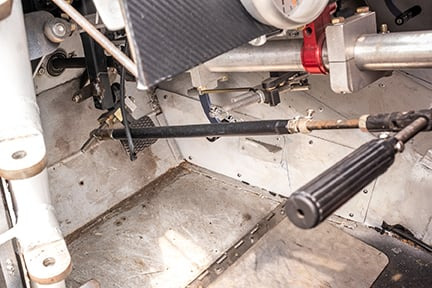
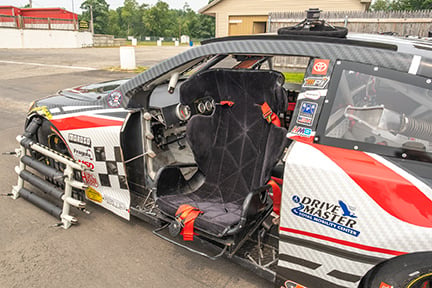
“Our push-pull hand brake is built by DriveMaster out of New Jersey,” Chrissanthis said. “They are the company that did a lot of the fabrication on our race car. The owner of that company, Peter Ruprecht, is our president.”
A passenger can sit on the left, where the normally sealed door in most stock cars can be opened for people with disabilities to get into the vehicle, and they’re able to access the hand controls if they want to do some of the driving.
Because of the unconventional seating position, the car also uses components of drag-racing vehicles to increase its safety, he said. Vehicles in NASCAR, for example, use the same left-hand driving as consumer American cars, but in stock car racing that becomes more important, since the right side of the car receives the impact in a crash.
That’s where Kevin Willey comes in. Willey, a police lieutenant then chief for a combined 14 years in Farmington, turned to worksite safety management after exiting law enforcement.
He and Chrissanthis met while working together for a construction group with a branch in Epsom, during which time Willey became ADE’s safety director. He’s helped develop safety protocols and trained people on how to operate the organization’s race car.
“All of our drivers, before they get in the car, are put through a safety briefing,” Willey said. The briefing includes checks on safety equipment; the steering column and wheel; proper seatbelt restraint; comfort of the occupants; and a review of the vehicle’s body and tires.
“When you’re talking about somebody that may have some sort of physical limitations, then it’s really important to explain to them what to do in the case of a crash or fire.”
Then, before taking a passenger with disabilities onto the racetrack, a driver performs hot laps: complete timed practice laps around the track as a final live test.
“I think a ton of credit goes to our drivers, because both of them have backgrounds in racing, but we’re putting them on the opposite side of the car, and everything they do feels differently than when they get in the car,” said Willey, who himself has raced in stock cars, including the ADE car.
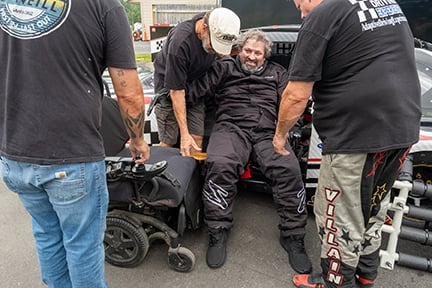
A New Hampshire car builder assembled the vehicle, and Ruprecht and the team at DriveMaster installed the adaptive modifications, Chrissanthis added. In total, he estimates manufacturing and developing the car cost between $75,000-$100,000 including labor fabrication costs, but most of the vehicle — like the engine, drivetrain, wheels and seats — was donated to ADE. As a nonprofit, the organization also raised about $25,000 for other necessary, miscellaneous parts.
The base car itself before modifications was bought out of pocket, but Chrissanthis expressed that it’s all worth it to him and the ADE team due to the nature of the project.
“We can take folks with a variety of disabilities, whether they’re amputees, paraplegic or quadriplegic,” Chrissanthis said. “You could even take somebody who was blind.”
Chrissanthis recalled meeting Matt Stutzman, a 42-year-old drag racer born without arms who drives vehicles solely using his legs and feet. Stutzman is better known for his archery, recently winning gold at the 2024 Paralympics in Paris.
“When you meet people like that, you realize there are some folks stepping up to a whole other level as far as what they’re capable of doing and willing to do,” Chrissanthis said. “They are truly the inspiration for me.”
Locally, Chrissanthis and his project team welcomed Granite Staters with disabilities to Epping’s Star Speedway on Aug. 15 for a demonstration event to share their impressions of riding in the car. Inclement weather prevented the ADE team from holding a full afternoon of racing demos, but Chrissanthis said those who managed to try out the car gave it the green light.
“A gentleman who came from Maine, Bobby Day, wasn’t even told he was driving a race car,” he said. “It’s something we planned six weeks before this took place; he’s a huge racing fan. When he pulled into (Star) and we said, ‘Dude, you’re about to drive that car,’ he was pretty excited.”
More positive reception that day came from Dave Martin, 75, of Hampton Beach, the father-in-law of ADE board member Sean McLaughlin and one of the drivers. The other is ADE Vice President Scott Vien, who doubles as a driving instructor for the vehicle.
Martin, a veteran who served in the U.S. Navy from 1968-1972, is an
amputee who lost his right leg, but not during his time in Vietnam.
Rather, the loss was in 2018 after he faced a triple aneurysm and
subsequent repair that cut off circulation to his foot and lower leg
before Martin made the call to have his lower leg up to his knee
removed. He now uses a prosthetic replacement for full mobility, but
that did not impede his test drive at Star Speedway.
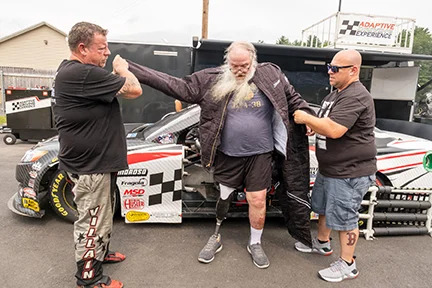
“It was comfortable, or as comfortable as it could be,” Martin said. “Usually when I’m riding or driving, I will take my prosthetic off my right leg, so I had them do that. The fire suits we were required to wear were brand new to me, so it was a little awkward. But all in all, I really enjoyed it — it was rattling me to my core driving around in that.”
His bigger takeaway from the experience was a sense of admiration and new respect for career NASCAR drivers after he tried just 15 laps around the track.
“They’re athletes to be able to go around these tracks 300-400 times,” Martin said. “You get a real appreciation of how well they’re put together.”
As far as bringing a vehicle like ADE’s car to the professional circuit goes, Chrissanthis says it’s likely not a realistic goal at this stage, but he did note that its chassis was designed by NASCAR engineers, and the nonprofit worked with an industry consultant linked to NASCAR to ensure a safe design.
Instead, Chrissanthis envisions the adapted vehicle on road courses and offering more test drives on days that professional races are held at New Hampshire Motor Speedway in Loudon to spread awareness of the nonprofit and its capabilities.
He also longs to bring a second car into the fold. That, he says, would continue ADE’s work, expand marketing opportunities and allow for a backup vehicle in case the other has a mechanical failure. It may also give ADE the chance to modify a Chevrolet or Ford to entice drivers more accustomed to cars from those manufacturers.
But that “all comes down to funding,” Chrissanthis notes, being a nonprofit.
“I feel like we’re building momentum and are on a roll here, and that we’ll hopefully start to attract some corporate sponsorship, some grants or people who want to get involved so we can make this organization grow,” Chrissanthis said. “Having someone more knowledgeable in nonprofits that can help with grant writing or fundraising (could help) grow the team.”
For now, Chrissanthis is proud of the work he and his ADE colleagues have achieved, and they intend to continue exhibiting their adapted race car at regional and industry car shows at Indy and in New England, company gatherings and whatever other events present themselves. But Chrissanthis remains prouder of those who demonstrate the vehicle’s ambitious function.
“A lot of people like to use the term ‘abilities’ as opposed to ‘disabilities,’ ” he said. “We know people that are doing extraordinary things without the use of an able body like we take for granted most of the time.
“When you get into a race car and you don’t have the use of four limbs to control that car, it takes even more talent and skill.”
Post a comment